
India's industrial production grew by 1 per cent in December, official data showed on Friday. According to the Index of Industrial Production (IIP) data, the manufacturing sector output grew by 1.6 per cent in December 2020.

Power generation and distribution is the most indebted sector

The RBI has targeted consumer price inflation at 6 per cent by January and 4 per cent by March 2018.

"Growth is expected to moderate gradually in China... pick up in India, and remain broadly stable in the Asean-5 region."
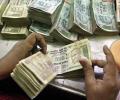
Experts said the higher pay out will boost consumption demand.

To make possible discretionary spending including capex and that on welfare, the government decided to borrow more than planned in FY21 -- Rs 12.7 trillion.

India's rupee is likely to remain under pressure due to high prices of crude oil and other commodities, and may stabilise at around 79-80 against the US dollar in the near term, say experts amid limited headroom available with the Reserve Bank to check the weakening of the domestic currency. The currency has slumped over 5 per cent this year after Russia's invasion of Ukraine sent international crude oil prices soaring to a decade high. On Monday, rupee ended at a fresh all-time low of 78.34 (provisional) against the US dollar.
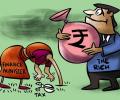
While the tax-to-GDP ratio of 9.88 per cent has been assumed for FY21, the same as last year, when it touched a decadal low, for FY22 a ratio of 10.7 per cent has been assumed, an average of the last five years.

Imports too declined 26 per cent to $29.47 billion in August, leaving a trade deficit of $6.77 billion.

Agriculture activity, according to recent channel checks by Prabhudas Lilladher, is expected to continue at a strong pace in FY22.

The government clarified that the majority of industrial establishments had reported nil production, and cautioned that the numbers should not be compared with those of previous months. "It is not appropriate to compare the IIP of April 2020 with that of earlier months, and users may like to observe the changes in the IIP in the following months," said the ministry of statistics & programme implementation.

Hardening prices of manufactured items during the month may refrain the Reserve Bank of India from cutting rates in its policy review on February 8.

Sectors with positive growth during the month include rice, iron ore, oil seeds, oil meals, meat, dairy and poultry products, pharmaceuticals, coffee, engineering goods, and plastic.

GST collections in March touched a record high of over Rs 1.23 lakh crore, a 27 per cent growth over the year-ago period, the Finance Ministry said on Thursday. "GST revenues crossed above Rs 1 lakh crore mark at a stretch for the last six months and a steep increasing trend over this period are clear indicators of rapid economic recovery post pandemic," the ministry said. Closer monitoring against fake-billing, deep data analytics using data from multiple sources including GST, income tax and customs IT systems and effective tax administration have also contributed to the steady increase in tax revenue over last few months, it added.
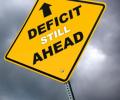
The deficit for the first five months of the year stood at 96 per cent of the full-year target of Rs 5.46 lakh crore despite cut in capital expenditure in August.

Deflation masked the rise in food inflation to a 5-month high.

Almost all infrastructure ministries continued spending on capex throughout the lockdown, even as the Centre tried to maintain some semblance of economic normalcy.

Direct economic stimulus measures such as tax cuts for individuals and industry would have helped to prop up the Indian economy which was hit hard by the lockdowns across several states in India, say economists and corporate leaders. While the measures announced on Monday are focussed more on the supply side, these steps would take a lot of time to move the needle for the economy.

Economic affairs secretary S C Garg said that all macroeconomic parameters are performing well.

Outlay for infra is also expected to see a significant increase in view of the government's Rs 111-trillion investment plan under the national infrastructure pipeline to develop social and economic infrastructure over five years.

While the farmers are not getting remunerative prices for their produce, at the same time they are forced to pay high prices for items they consume.
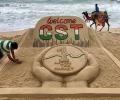
Mop up grows 10% y-o-y at Rs 1.05 trillion, almost equal to levels in February before a nationwide lockdown to contain the coronavirus pandemic

Experts said the slowdown could be attributed to adjustments leading to destocking and the offering of discounts by companies as the government ushered in the new indirect taxation system on July 1.

Index of industrial production data had also shown that the sector grew at 3.1 per cent after contracting in the previous quarters.

India's economic growth accelerates to 7.4% in Sept quarter

The retail inflation, which is factored in by the RBI to arrive at its monetary policy, has been on decline since last month. The previous low was 5.54 per cent in November 2019. The government has asked the RBI to restrict the inflation around 4 per cent, with a margin of 2 per cent on the either side.

Direct tax collections grew by a meagre 6.6 per cent during April-July of the current financial year against the Budget target of 14.4 per cent for 2018-19. Corporation taxes, in particular, grew at just 0.57 per cent, the lowest in the first four months in at least seven years.

India's appetite for imported crude oil may wane in fiscal year (FY) 2023 from record levels in pre-pandemic 2019-20 fiscal as higher oil prices, a spillover from the conflict in Ukraine, and increasing use of biofuels affect domestic demand for petroleum products. Brent crude surged to a nine-year high, shy of a July 2008 record $147.50 a barrel, before declining to around $100 a barrel - but the volatility in commodity rates will slow global economic growth and use of fuels. Demand for all oil products may grow at only 2-3 per cent in FY23, slower than the current fiscal and nearly half the 5.5 per cent growth estimated by the petroleum ministry, according to industry officials.

Import segments which recorded negative growth include gold, silver, transport equipment, coal, fertiliser, machinery and machine tools. However, exports of oil seeds, coffee, rice, tobacco, spices, pharma, and chemicals reported positive growth in June.

After the government sought Parliament's nod for a second batch of supplementary demand for grants that will cause a hit of Rs 2.99 trillion to the exchequer, doubts suddenly arose about the government's ability to meet the Budget projections of reining in its fiscal deficit at 6.8 per cent of gross domestic product (GDP), or Rs 15.06 trillion, for the current financial year. Till now, many were of the opinion that the government would succeed in checking the deficit at a much lower figure than what was given in the Budget Estimates (BE). The government had sought Parliament's approval to spend Rs 3.74 trillion extra, but Rs 74,517.01 crore will be matched by equal savings on other heads.

India showed revival signs in the March quarter.

RBI targets to keep inflation at 4 per cent, (+/- 2 per cent), and its rise beyond this comfort zone will put pressure on the central bank to hike rates.

Central bank moves to infuse liquidity into bond market to help boost sentiment.

Growth was primarily pushed by a jump in steel and electricity generation, apart from a sustained rise in natural gas output.

WPI inflation, which was in the negative zone from November 2014 to March 2016, has been on an upward trend for the seventh straight month

A collapse in global oil prices has unleashed a wave of monetary easing.

The retail inflation rate breached the 6 per cent upper tolerance limit of the RBI for the first time in seven months in January, while the wholesale price index stayed in double-digits for the 10th month in a row, showed two sets of data released by the government on Monday. Retail inflation, the key input for the RBI while reviewing the repo rate every two months, soared during the month mainly because of a spike in certain food items. The previous high for retail inflation was 6.26 per cent in June 2021.

The revision will do little to help the Congress party-led ruling alliance, which faces an uphill battle in elections due by May amid allegations of economic mismanagement, corruption scams and high inflation.

Build up inflation rate in the financial year so far was 2 per cent compared to a build up rate of 4.56 per cent in the corresponding period of the previous year. Inflation in food articles as a group rose to 11.08 per cent during the month as against 9.80 per cent in the previous month, mainly driven by exorbitantly high onion prices, the rates of which spiked by over 172 per cent from a year-ago. The annual rate of inflation, based on monthly wholesale price index was at 0.16 per cent in October.

Welcoming the latest round of stimulus announced by Finance Minister Nirmala Sitharaman on Thursday, experts said the measures will support the economic recovery boosting demand, job creation and by providing funds to the MSME and stressed sectors. The fiscal impact of the stimulus is likely to be around 0.25-0.6 per cent of GDP in the current fiscal, they said.
